Chapter 1 · The Delta Electrified
B.B. King
The King of the Blues · Memphis & National Circuit · 1950s–1960s
Rock & Roll Hall of Fame, 1987“When I sing, I play in my mind; the minute I stop singing orally, I start to sing by playing Lucille.”
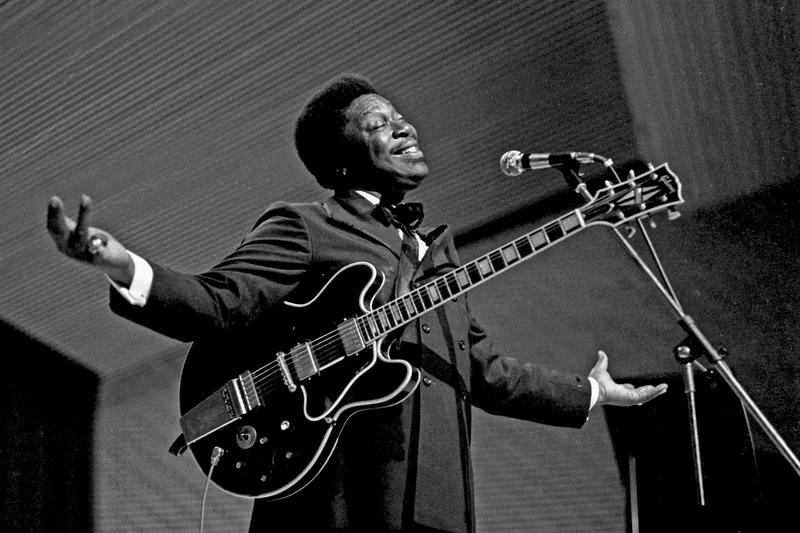
B.B. King performing at Universität Hamburg, November 1971 — licensed CC BY-SA 2.0
The Story
Riley B. King redefined the electric guitar by stripping away rhythm strumming to focus entirely on precision, vocalized string bends, and his signature finger vibrato. He transformed the guitar into a second, lead voice for the singer — a technique he named after his guitar, Lucille.
That call-and-response between King's voice and his guitar became the direct template for nearly every rock guitar solo that followed, from Eric Clapton and Jimi Hendrix to Stevie Ray Vaughan.
Sound & Gear Breakdown
- Singing finger-and-wrist vibrato
- Call-and-response dynamics between voice and guitar
- Economical, soul-drenched solo phrasing over full-band swing
Essential Listens
The Thrill Is Gone (1969)
The benchmark for dynamic, expressive blues-rock guitar phrasing.
Sweet Little Angel (1956)
A classic electric blues standard built entirely around textbook bend intonation.
Legacy Impact
Formed the entire lead-guitar vocabulary used by Eric Clapton, Jimi Hendrix, Stevie Ray Vaughan, and virtually every rock guitarist since.
Lineage to Today
Any guitarist we book who plays fewer notes but makes each one count is following King's rulebook — restraint and vibrato over speed is still the mark of a great live soloist.